When a hotel developer first approaches Oak & Teak Interior about a fit-out project in Nigeria, the furniture conversation almost always starts too late. The architectural drawings are nearly final. The construction team has already committed to the construction program. And one critical question remains unanswered: what furniture, fixtures, and equipment do we actually need? Where does each item go? Who supplies it? And when must it arrive on site so it does not delay the opening?
This is precisely what an FF&E procurement plan answers. And this is the exact process Oak & Teak Interior uses to build one for every commercial and residential project we manage, from boutique hotels in Lagos to corporate headquarters in Abuja, bank branch fit-outs across Nigeria, restaurant groups, healthcare facilities, student housing, and luxury homes for clients in Nigeria and internationally.
This article is not a beginner’s glossary. It is a transparent account of how Oak & Teak builds an FF&E procurement plan from scratch, what it contains, how the timeline works by sector, and what separates a plan that delivers on budget and on schedule from one that causes delays, substitutions, and costly handover failures.
What Is an FF&E Procurement Plan and Why Does It Matter?
An FF&E procurement plan is a structured document that specifies furniture, fixtures, and equipment items required for a project. It defines each item’s location, cost, supplier, delivery date, and installation method. Without this plan, commercial projects in Nigeria regularly experience delays, budget overruns, and specification failures that are difficult and expensive to correct after handover.
FF&E stands for Furniture, Fixtures, and Equipment. Within hotel projects, FF&E includes beds, wardrobes, seating, lighting, carpets, curtains, mirrors, and other physical elements that are not permanently fixed to the building structure. Corporate office environments require workstations, seating, storage units, partitions, reception furniture, and specialist equipment. Meanwhile, healthcare facilities require patient furniture, clinical storage, staff workstations, and sector-specific compliance items.
FF&E vs. OS&E: Understanding the Full Scope
OS&E (Operating Supplies and Equipment) covers the linens, cutlery, crockery, uniforms, and consumables that an operation requires to function once the FF&E is in place. Hospitality projects require FF&E and OS&E procurement to be coordinated because neither is complete without the other, and both must arrive in time for staff training before opening.
At Oak & Teak, we manage FF&E procurement as part of our integrated turnkey interior design service in Nigeria. For larger hospitality and commercial projects, we also coordinate OS&E procurement in parallel with the FF&E programme. For a full explanation of how this integrated model works from brief to handover, see our guide on turnkey interior design in Nigeria.
What Should Be Included in an FF&E Procurement Plan?
A complete FF&E procurement plan includes a room-by-room product specification schedule, quantity schedules, budget allocations per line item, supplier and lead time information, a procurement timeline built backwards from the handover date, sample and approval tracking, order status tracking, and a substitution protocol for items that become unavailable.
The Core Components of Every Oak & Teak FF&E Plan
At Oak & Teak Interior, our FF&E procurement plan always contains these seven components:
- Product Specification Schedule.The procurement team lists every item by room type, including the product name, dimensions, material finish, color reference, quantity, and item code.
- Room-by-Room Quantity Schedule.The project team cross-references the total quantity of every item against the room count and reviews it against the architectural drawings before ordering.
- Budget Allocation.Budgeted unit cost and total cost per line item, with running totals per room category, per floor, and per project phase.
- Supplier Matrix.Primary supplier, alternative supplier, country of origin, lead time, minimum order quantity, and payment terms for every specified item.
- Procurement Timeline.Built backwards from the project handover date, showing the latest order date, expected delivery date, and installation window for every item.
- Approval Tracker.Status column showing whether each item is specified, sampled, approved, ordered, in production, shipped, in customs clearance, in storage, or delivered to site.
- Substitution Log.A documented record of any items changed from the original specification, including the reason, the approved alternative, and the client approval reference.
The discipline behind this structure helps prevent the most common FF&E procurement mistakes, including substitutions made without design review, late arrivals caused by misunderstood lead times, and budget overruns resulting from untracked order amendments.
How Does Oak & Teak Create an FF&E Procurement Plan Step by Step?

Oak & Teak Interior creates an FF&E procurement plan through a seven-stage process during design development and continuing through supplier qualification, specification, sample approval, order placement, logistics management, and on-site installation. The project team documents and tracks every stage against the construction program from the outset.
Stage 1: Brief and Area Schedule
The FF&E procurement process begins with a complete area schedule derived from the architectural drawings. For a hotel project in Nigeria, this means every room type, room count, corridor zone, lobby, restaurant, meeting room, back-of-house area, and external terrace. For an office, the schedule covers workstations by department, meeting rooms by size, reception zones, breakout areas, and executive offices. This schedule forms the scope boundary of the entire procurement plan.
Stage 2: Design Development and Product Specification
The design team translates approved concepts into detailed product specifications that let suppliers to prepare accurate quotations: exact dimensions, material finish codes, structural requirements, fire and safety compliance where applicable, and any bespoke manufacturing requirements. Vague specifications produce vague quotes, which produce procurement surprises. Specific specifications produce reliable quotes.
Stage 3: Supplier Qualification and Sourcing
Our procurement team identifies qualified suppliers for every item category. For projects in Nigeria, we evaluate local manufacturers, Lagos- and Abuja-based importers, and direct international suppliers based on lead time, quality standard, and price against specification. For complex hospitality projects, we source products from multiple countries and consolidate them in a warehouse before final delivery to the site.
Stage 4: Quotation, Negotiation, and Budget Reconciliation
Our procurement team obtains competitive quotations for every line item. We negotiate pricing against the approved specifications. We reconcile the total against the approved FF&E project planning budget. Where reconciliation reveals a gap, we present substitution options that maintain design intent without compromising quality in the areas the client or their guests will notice.
Stage 5: Sample, Review, and Approval
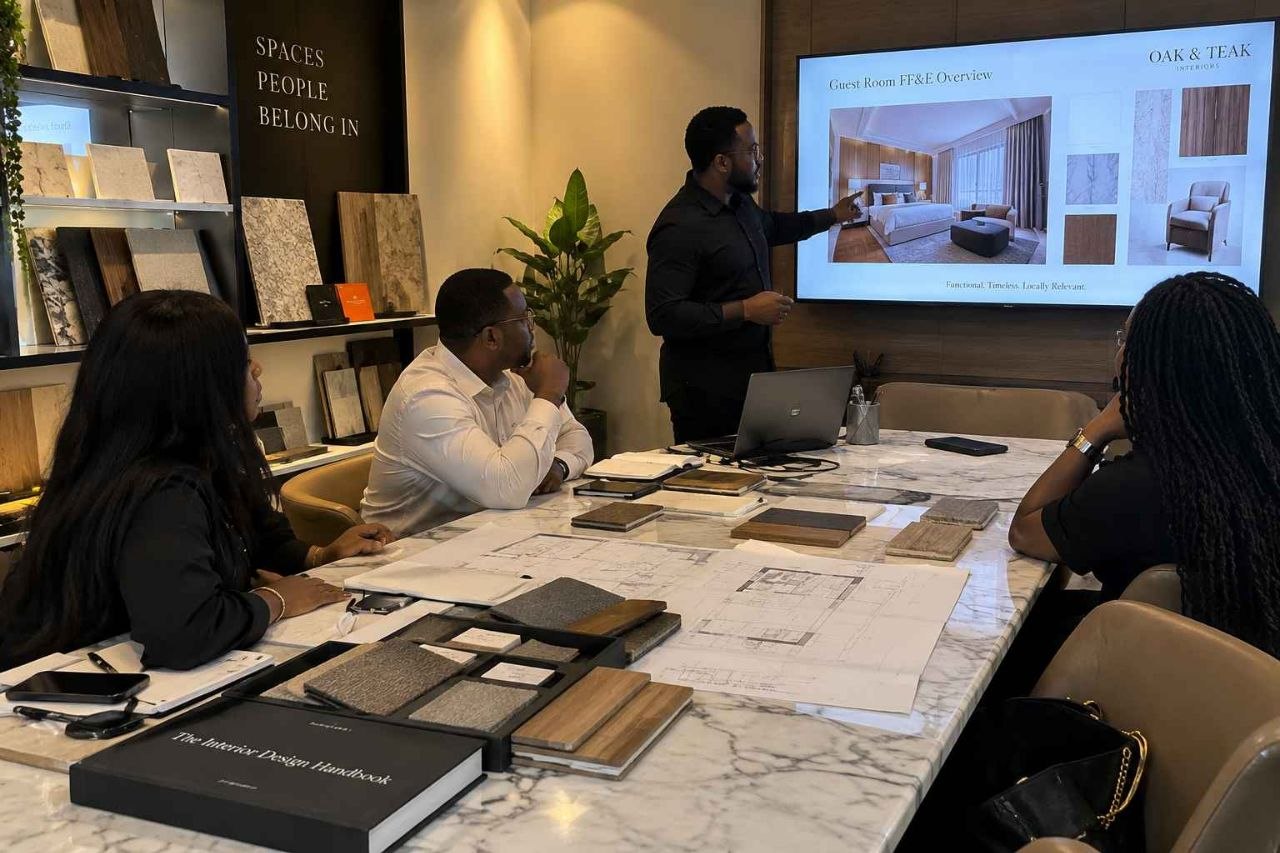
We present physical samples of every significant item to the client before placing any orders. Hospitality projects typically require a fully dressed mock-up room containing all specified FF&E before the client grants final approval. This stage prevents the single most expensive failure in hospitality fit-out: receiving 200 guest room packages that do not meet the standard the client approved.
Stage 6: Order Placement and Production Tracking
Our procurement team places orders against confirmed supplier agreements. We track production against the agreed manufacturing milestones. For imported items, we manage shipping documentation, Nigerian customs clearance, port handling, and inland logistics as part of the furniture procurement process.
Stage 7: Delivery, Installation, and Snagging
Our logistics team receives every item, inspects it against the approved specification on arrival, and schedules installation in line with the construction program. Our on-site team manages the installation order, resolves discrepancies against the approved specification, and produces a snagging list before handover. We do not sign off any item until it passes inspection against the approved sample or drawing.
Follow Oak & Teak Interior’s FF&E procurement updates and project documentation on Instagram and LinkedIn: real projects, real process, and real results.
Who Manages FF&E Procurement on a Construction Project?
On construction projects in Nigeria, the interior designer, a dedicated FF&E procurement consultant, or the main contractor manages FF&E procurement. In integrated models like Oak & Teak Interior’s approach, the interior design team manages the full FF&E procurement scope; this integrated system preserves the approved design intent from specification through delivery and installation.
Why Integration Between Design and Procurement Matters
The most common FF&E procurement risk on Nigerian construction projects occurs when the interior designer specifies items but does not manage procurement, and a contractor or procurement agent substitutes products without design review. The completed space does not match the approved design. Substituted items are cheaper or more available but create visual and quality inconsistencies that are difficult and expensive to correct after handover.
At Oak & Teak Interior, we manage both design specification and procurement execution under one team. This integration ensures that what was designed is what is delivered. It also allows us to track every substitution against the approved specification, maintain budget control in real time, and manage the supplier and logistics complexity that multi-category procurement on a tight construction program requires.
For clients evaluating whether a single integrated team or a split design-procurement model is right for their project, our guide on what an office interior fit-out company does explains how these two models compare in a commercial fit-out context.
How Oak & Teak Manages FF&E Procurement by Sector

Oak & Teak Interior manages FF&E procurement across six primary sectors in Nigeria: hotels and hospitality, corporate offices and banks, restaurants and commercial food spaces, hospitals and healthcare facilities, luxury residential properties, and student and senior living facilities. Each sector has specific functional, regulatory, and performance requirements that the procurement plan must address from the specification stage.
Hotels and Hospitality
Hotel FF&E procurement in Nigeria requires managing item categories simultaneously within a construction program that does not accommodate delays. A 100-room hotel may require 150 to 250 individual FF&E line items across guest rooms, corridors, lobbies, restaurants, meeting rooms, wellness areas, and back-of-house facilities.
For hotel renovation projects with operations continuing, our FF&E procurement plan for hotel renovation in Nigeria includes a phased delivery schedule that allows block-by-block refurbishment without requiring the hotel to close entirely. Items are delivered and installed floor by floor, with logistics timed to avoid interference with occupied areas.
Corporate Offices and Banks
Bank interior design contractors in Nigeria and corporate furniture procurement in Nigeria require compliance with functional standards that go beyond aesthetics. Banks have security zoning requirements, durability thresholds for high-traffic surfaces, and brand consistency requirements across every branch location.
For multi-branch corporate clients, our FF&E procurement plan for office fit-out ensures that every item across every location meets the same specification, whether the branch is in Lagos Island, Abuja FCT, or Port Harcourt GRA. For executive and leadership workspaces specifically, our guide The Signs Your Office Needs a Redesign covers the distinct FF&E requirements of senior office environments.
Restaurants and Commercial Food Spaces
Restaurant interior design in Lagos and across Nigeria presents a specific FF&E challenge: front-of-house furniture must be durable enough to withstand the use intensity of a busy food service environment while remaining visually consistent with the brand identity.
Our restaurant interior design FF&E procurement plan separates front-of-house and back-of-house items, applies different durability specifications to each zone, and builds in a replacement cycle plan for high-wear items. For commercial bespoke furniture within restaurant environments, our guide on why Nigeria’s best commercial spaces use a bespoke furniture company explains how custom production fits into the FF&E procurement scope.
Hospitals, Clinics, and Healthcare Facilities
FF&E procurement for healthcare facilities in Nigeria requires compliance with healthcare-specific material and surface standards. Antimicrobial surface requirements, infection control considerations, patient comfort specifications, and the operational demands of a 24-hour facility affect every specification decision in the FF&E procurement plan for healthcare facilities.
Healthcare FF&E procurement also requires coordination with medical equipment suppliers, whose delivery schedules and installation requirements must be integrated into the FF&E program. Failing to synchronize these two procurement streams is one of the leading causes of delays in opening healthcare facilities.
Luxury Homes and High-End Residences
For luxury home interior design in Lagos and across Nigeria, FF&E procurement operates at a different quality tier. Our procurement process for luxury residential projects includes international sourcing, import management, and coordination with bespoke furniture manufacturers producing pieces that cannot be sourced from a standard catalogue.
A luxury home FF&E specification may combine locally manufactured custom pieces from our Oak & Teak furniture manufacturing service, regionally sourced items, and direct imports from Europe, Asia, and the UAE, all coordinated into a single delivery and installation program tailored to the construction completion schedule.
How Long Does FF&E Procurement Take?
FF&E procurement timelines in Nigeria depend on the project type, the number of line items in the specification, and the proportion of imported versus locally sourced items. Simple office fit-outs require 4 to 8 weeks. Mid-scale hospitality projects typically require 12 to 20 weeks. Large hotel or healthcare projects with significant imported FF&E require 5 to 12 months from confirmed specification to completed installation.
FF&E Procurement Timeline by Project Type in Nigeria
| Project Type | Approx. Line Items | Procurement Duration |
| Small office or clinic (under 500 sqm) | 20 to 50 items | 4 to 8 weeks |
| Restaurant or boutique retail (under 300 sqm) | 30 to 80 items | 6 to 12 weeks |
| Medium corporate office (500 to 2,000 sqm) | 80 to 200 items | 8 to 16 weeks |
| Boutique hotel (20 to 50 rooms) | 100 to 250 items | 12 to 20 weeks |
| Hospital or large healthcare facility | 150 to 400 items | 16 to 30 weeks |
| Large hotel or resort (100+ rooms) | 200 to 500+ items | 20 to 48 weeks |
| Luxury residential (full home) | 50 to 150 items | 8 to 20 weeks |
Key assumption: All timelines begin from a confirmed and approved FF&E specification. Projects where specifications are still being revised during procurement will extend proportionally. Nigerian port clearance for imported items adds 2 to 6 weeks beyond shipping duration and must be built into the program from the outset.
For a deeper understanding of how FF&E procurement fits within the broader interior design project lifecycle, our guide on how to plan your home interiors before construction starts explains how procurement planning integrates with the construction program from the earliest stage.
How Do You Avoid Delays in FF&E Procurement?
To avoid delays in FF&E procurement in Nigeria, confirm and lock the specification before placing any order, build the procurement timeline backwards from the handover date with realistic lead time buffers, begin customs documentation for imported items well in advance of the shipping date, and maintain an approved substitution ready for every high-risk line item before procurement begins.
The Most Common FF&E Procurement Mistakes in Nigeria
From managing FF&E procurement across hotels, offices, banks, healthcare facilities, and luxury homes in Nigeria, these are the mistakes that cause the most delays and the most budget overruns:
- Specifying items before the room count is confirmed.Quantity errors require re-ordering, and re-orders rarely arrive in time for the original installation window.
- Ordering imported items without factoring in Nigerian port clearance.Port clearance adds 2 to 6 weeks beyond shipping duration and is non-negotiable. Plans that ignore this consistently fail.
- Accepting supplier lead times without production delay buffers.Manufacturing delays are common. A plan with no buffer has no recovery option when a supplier misses a milestone.
- Allowing design changes after orders are placed.Changes either generate cancellation costs or force the project to accept the original specification despite the design revision.
- Failing to inspect received items against specification on delivery.Discovering non-compliance at installation, when it is too late to reorder, is the most expensive point at which to find a problem.
- Having no approved substitution ready for high-risk items.Every imported item with a lead time over 8 weeks should have a pre-approved local alternative in the plan before procurement begins.
For context on how proactive planning protects the overall project budget, our guide on whether an interior designer can save you money in Nigeria covers the specific cost relationship between planning quality and project spend.
How Does Oak & Teak Handle International FF&E Procurement?
Oak & Teak Interior manages international FF&E procurement for Nigerian projects, which will require imported items from international suppliers, including purchase order management, shipping coordination, Nigerian customs clearance, port handling, inland logistics, and final delivery and installation on-site. Oak & Teak also manages FF&E coordination for Nigerian clients commissioning interior projects from international locations.
We have managed international FF&E sourcing from the United Kingdom, Italy, Turkey, China, and the UAE for commercial and residential projects across Lagos, Abuja, and Port Harcourt. Our logistics process for imported items includes pre-shipment quality inspection, full shipping documentation management, Nigerian import duty calculation, and port clearing agent coordination.
For clients based outside Nigeria who need to manage an interior design and FF&E project remotely, our guide on how to hire an interior designer while living abroad covers the complete remote coordination structure we use for international clients, including how approvals, quality checks, and progress reporting work when the client is not physically present in Nigeria.
You can also follow our international project updates and procurement process documentation on Instagram and LinkedIn, where we regularly share behind-the-scenes content from active procurement and installation projects.
How to Start Your FF&E Procurement Project With Oak & Teak
To start an FF&E procurement project with Oak & Teak Interior in Nigeria, clients can engage at three points: before design begins (for integrated design-and-procurement delivery), after design is complete (for procurement execution only), or mid-project (to rescue a program that has experienced delays or specification failures).
Clients come to Oak & Teak for FF&E procurement services at different stages. Some engage us from the very beginning as the integrated design-and-procurement team. This is the most efficient model and the one that produces the most consistent outcome between design intent and final delivery.
Others engage us to take over FF&E project management for projects where another party handled the design, and the client needs a qualified procurement team to manage the FF&E schedule and coordinate it with the construction program.
And others engage us to review and recover a procurement program that has already experienced delays, specification failures, or supplier problems. In all three cases, our process begins with a full assessment of what has been specified, what has been ordered, what remains outstanding, and what the remaining program allows. From that assessment, we produce a clear plan.
For an overview of our completed commercial FF&E and interior design work across multiple sectors, browse Oak & Teak Interior’s commercial project portfolio. For clients who want to understand the full scope of what working with Oak & Teakinvolves, from brief to handover, our guide to the interior fit-out services Oak & Teak provides covers every stage of the commercial interior and fit-out process.
Ready to discuss your FF&E procurement project? Book a consultation with Oak & Teak Interior, or connect with us directly on Instagram or LinkedIn to send us your brief and get a response from our commercial team.
A Good FF&E Procurement Plan Is the Difference Between a Project That Opens on Time and One That Does Not
The conversations we dread most at Oak & Teak are the ones that start with: ‘The hotel was supposed to open last month, but the furniture is stuck at the port.’ Or: ‘The office fit-out is done except the boardroom table, and the CEO is expecting to use it next week.’
Both are avoidable. And both are the result of an FF&E procurement plan that was built too late, with too little specificity, and without the lead-time buffers that Nigerian logistics genuinely require.
Build the plan correctly at the beginning. Manage it actively throughout. Deliver on time. Speak to Oak & Teak Interior about your project today.
Frequently Asked Questions (FAQs)
Q: What is an FF&E procurement plan and why does it matter?
A: An FF&E procurement plan is a structured document specifying every item of furniture, fixture, and equipment required for a project, including what each item is, where it sits, what it costs, who supplies it, and when it must arrive. Without this plan, commercial projects in Nigeria regularly experience delays, budget overruns, and specification failures that are expensive to correct after handover.
Q: What should be included in an FF&E procurement plan?
A: A complete FF&E procurement plan includes a room-by-room product specification schedule, quantity schedules, budget allocations per line item, supplier and lead time information, a procurement timeline built backwards from the handover date, sample and approval tracking, order status tracking, and a substitution protocol for items that become unavailable.
Q: How does Oak & Teak create an FF&E procurement plan step by step?
A: Oak & Teak creates an FF&E procurement plan through seven stages: brief and area schedule, design development and product specification, supplier qualification and sourcing, quotation and budget reconciliation, sample review and client approval, order placement and production tracking, and delivery, installation, and snagging.
Q: Who manages FF&E procurement on a construction project?
A: On construction projects in Nigeria, FF&E procurement is managed by the interior designer, a dedicated procurement consultant, or the main contractor. Oak & Teak Interior manages both the design specification and the procurement execution under one integrated team, ensuring design intent is preserved from specification through to installation.
Q: How long does FF&E procurement take?
A: FF&E procurement in Nigeria takes 4 to 8 weeks for small office or clinic projects, 12 to 20 weeks for boutique hotel projects, and 20 to 48 weeks for large hotels or resorts. All timelines assume a confirmed and approved specification before procurement begins. Nigerian port clearance for imported items adds 2 to 6 weeks beyond shipping duration.
Q: How do you avoid delays in FF&E procurement?
A: To avoid FF&E procurement delays in Nigeria: lock the specification before placing any order, build the procurement timeline backwards from the handover date with realistic port clearance buffers, maintain an approved substitution for every high-risk imported item before procurement begins, and inspect all received items against specification on delivery rather than at installation.
Q: How does Oak & Teak handle international FF&E procurement?
A: Oak & Teak Interior manages international FF&E sourcing from the UK, Italy, Turkey, China, and the UAE for projects in Nigeria, including purchase order management, pre-shipment inspection, shipping coordination, Nigerian customs clearance, inland logistics, and on-site installation. Oak & Teak also manages FF&E projects for Nigerian clients based internationally.
Q: How do interior designers manage FF&E procurement?
A: Interior designers manage FF&E procurement by translating the approved design into a product specification, qualifying suppliers, obtaining and negotiating quotations, managing the approval process, tracking production and logistics, coordinating delivery against the construction program, overseeing installation, and managing snagging before handover.
Q: How is FF&E calculated?
A: FF&E is calculated by reviewing the approved architectural drawings, room schedules, furniture layouts, and operational requirements to determine the quantity, specification, and budget for every furniture, fixture, and equipment item. The calculation also considers installation costs, freight, customs duties, warehousing, contingency allowances, and project timelines. As part of an FF&E procurement plan, every item is documented to support accurate budgeting, procurement scheduling, and supplier coordination. This structured approach is essential for hotels, offices, restaurants, healthcare facilities, and other commercial developments in Nigeria.
Q: What is the difference between FF&E and CapEx?
A: FF&E refers to movable assets such as furniture, lighting, loose equipment, artwork, and accessories that can be replaced without altering the building structure. Capital expenditure (CapEx), on the other hand, covers permanent building components such as structural works, electrical systems, plumbing, HVAC, flooring, and fixed architectural finishes. A well-developed FF&E procurement plan separates these procurement packages while coordinating them within the overall construction program. This distinction improves budget control, reduces procurement conflicts, and supports effective FF&E project planning throughout the project lifecycle.
Q: What does FF&E stand for?
A: FF&E stands for Furniture, Fixtures, and Equipment. It includes all movable items required to furnish and equip a completed space, including office furniture, hotel bedroom furniture, reception desks, restaurant seating, decorative lighting, artwork, window treatments, and other operational equipment. As part of the FF&E procurement process, these items are specified, sourced, purchased, delivered, and installed through a structured FF&E procurement plan. Professional FF&E sourcing helps ensure every product meets the project’s design intent, budget, quality standards, and construction timeline. Whether the project involves hotels, offices, luxury residences, or clinic/hospital interior design in Nigeria, proper FF&E planning contributes to a successful project handover.